

Learn to be Still
What a dream visitor taught me about the difference between slowing down and becoming still

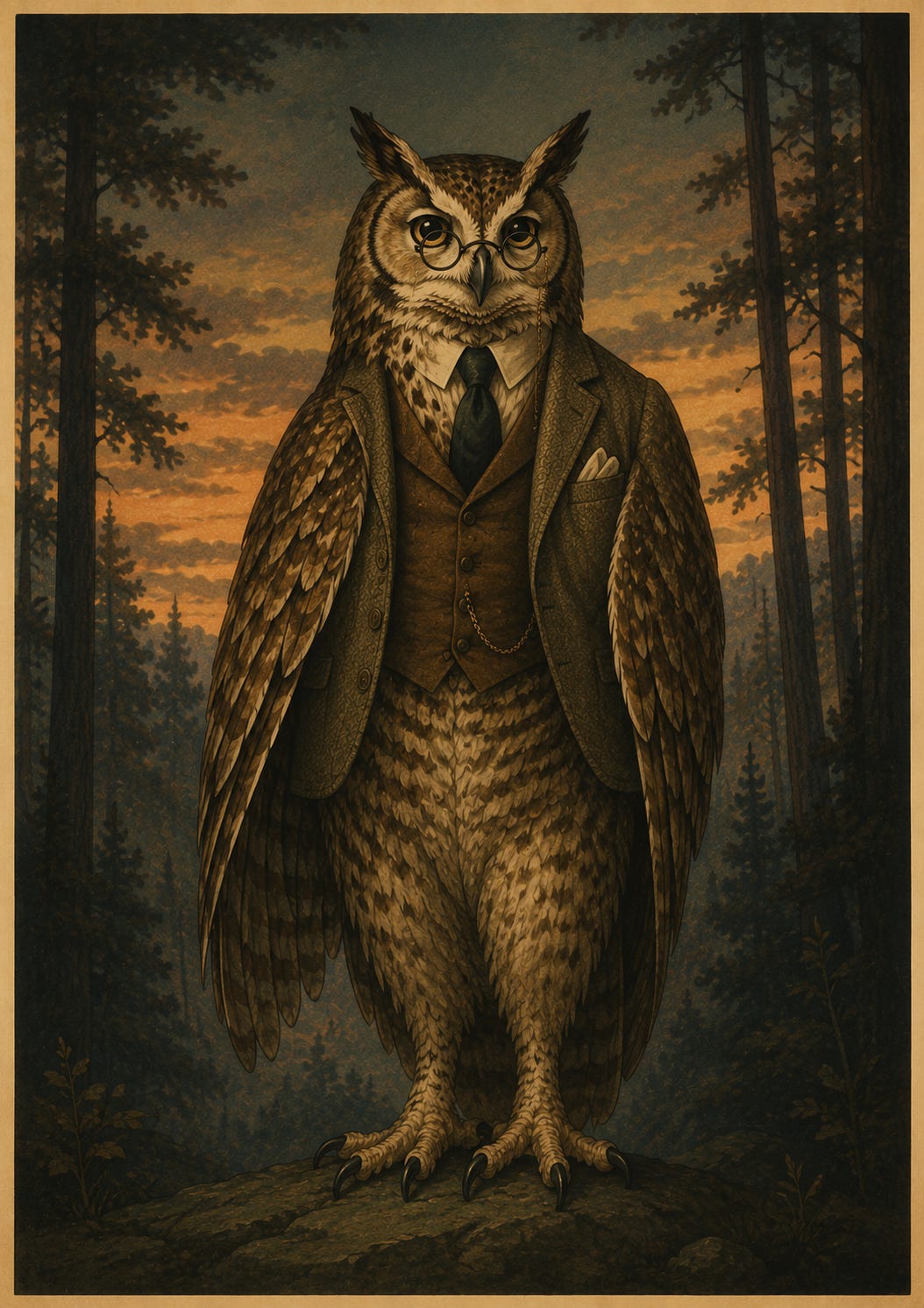
An owl can sit so still that it no longer appears to be alive. This is not rest, and it is certainly not absence. It is attention in its most concentrated form, a wild alertness so complete that the bird blends into the forest it inhabits. From within that motionless poise, an owl can detect the faintest tremor of a mouse beneath the leaves, the smallest shift in a world that believes itself unwatched. I think the owl visited my dreams to teach me this.
The image arrived a few nights before my most recent dreamweaving circle: a tall, owl-like figure, partly cartoonish, bespectacled, rendered in the style of an old-fashioned postcard. The feeling that came with it was that of benign watcher. He embodied the kind of teacher whose observance makes you feel supported, not watched, whose attention feels like shelter. The owl brought a big quiet felt sense, and no need for words.
When I brought the image into our circle and spent time with it in active imagination, the owl became more animal-like and wild. Perched high in a tree, its senses sharpened into acute vision and hearing tuned to registers only animals can sense. And as it grew wilder, it also grew more still, watchful and infinitely patient.
Slow is not the same as stillness
I have been writing recently about the desire to slow down, and I know I am not alone in this. Many of us feel the pull toward a gentler pace, fewer commitments, more space between things. But sitting with the owl, I see that slowing down is not the same as stillness. Slowness has movement, just at a more humane pace. Stillness is different in kind, not merely in degree, and it asks something else of us entirely.
The analogy that comes to me is from tennis, of all places, a sport I love and play almost daily. When I am moving, and the ball is moving, and the other players are moving, it is hard to find focus. But the moment I stop, split-step however briefly, I can see the ball and strike it cleanly. The owl is like this: it sits utterly motionless so it can catch the movement of something tiny. I believe this holds true for observing dream images, or our interior landscape, or the world itself. The more still we are, the more precisely we can see.
When one sense goes dark
There is a perceptual phenomenon that feels relevant here. When we turn off one sense, the others heighten. Close your eyes and your hearing sharpens; sit in darkness and you can hear faint stirrings. The body reallocates its attention. I think something similar happens on a deeper level when we quiet not just one sense but the whole sensory appetite, the constant reaching for stimulation that has become the texture of modern life. The podcast on the walk, the scroll before sleep… these small gratifications keep our attention facing outward.
One of my favorite bands, the Eagles, knew this restlessness. In the song that lends this piece its title, Don Henley sings, “You thought you could find happiness just over that green hill, you thought you would be satisfied, but you never will… learn to be still.” Henley wrote the song with drummer Stan Lynch for the band’s 1994 reunion album, and the lines have only grown truer since. The next dopamine hit never fully satisfies, and some part of us has always known it.
What I noticed, sinking into stillness with the owl, is that when the outer senses settle, an inner sense has a chance to arise. This is familiar territory for anyone who practices focusing, Eugene Gendlin’s method of listening into the body. The felt sense does not announce itself over the noise. It waits, like something shy and wild, for enough quiet to emerge. Our inner wisdom seems to operate on the same principle: it cannot be summoned on demand, but it will come forward reliably when we learn to be still enough to receive it.
Witnessed without judgment
The circle took my owl and made it their own, which is the great gift of dreamweaving. One member described the owl’s gaze as witnessing without judgment, and noticed how different it felt to be watched by something non-human. Human observation so often carries evaluation in it, a quality we learn to brace against. The owl’s watching had none of that, and in its presence he felt free to play, to move, to be unguarded. Another member offered that in stillness there is implied movement, the way a silence in music is not emptiness but transition. A third felt the owl visit each dream in our collage in turn, slowing each moment down so its wisdom could be absorbed.
We ended up working with the polarity of stillness and movement directly, in the manner of Jung’s tension of opposites: holding both poles at once, without leaning into either, and waiting for a third thing to emerge. The image that came to me in our closing round was a photograph of a dancer mid-swirl, the photograph perfectly still, the movement captured inside it.
Wisdom without words
I keep returning to the feeling of the owl as teacher. My dream owl was benign -- supportive rather than predatory, and so quiet. Teaching, like therapy, tends to reward speech: the apt intervention, the well-timed insight, the explanation that lands. But the dream-owl offered its wisdom via presence alone, watching without interfering, offering company without direction, confident that whatever needed to unfold would do so.
This is harder than it sounds. To sit in supportive silence requires quelling the urge to be useful, which is its own form of sensory appetite, the desire to see our effect on things. The owl is wild, self-contained, complete. I aspire to be that kind of teacher, and that kind of listener, both to others and to my own inner landscape. Still enough to catch the small movements. Silent enough that what is shy and hidden feels safe enough to show itself. There is strength in that benevolent silence. It says: I am here, I see you, and I trust what is emerging in you more than anything I might add to it.
I love this Leslie, I'm really drawn to this right now too and loved how you described the sense of it.
appreciate this - particularly the difference between slow and still helps to land there. thank you