

There is no hurry
Speed is the enemy of depth

By Leslie Ellis
There is a kind of presence that settles like a blanket over two people at rest, perhaps over a cup of tea, or staring out at the ocean, the conversation interspersed with comfortable silences. There is a felt sense of safety when the other person is really with you – no drifting attention, no pressure to get a point across. When you bring this relaxed, invitational presence to your own self, it carries you into the generative territory of liminal space and of dreaming.
If we do no more than take a cursory glance at our dream material, we are prone to judge it as nonsensical, or as a trivial waste of our time. But if you approach dream objects with reverence, their deep and sacred nature is revealed. If you approach them with playful curiosity, their sense of humor may arise. What comes to us from dreams depends on how we approach them, and from pausing long enough for the dream to respond in kind.
We all know that modern life pushes us into the fast lane. Social media encourages this, giving addictive little dopamine hits as we scroll through short loops designed to catch our interest. Even little kids are overscheduled and screen-addicted, leaving little time for the freeform imaginative play so essential to their well-being and development. It’s stressful as well, so many of us living with the perpetual sense that we are already late for something.
Our bodies are not designed to live this way. In my continued, and only partly successful effort to slow down, I made a big move away from city life to a small island. Here, the pace of life is more humane, people have time for each other, give back more to the community. It’s possible to slow down, take a deep breath and drink in the abundant natural beauty that is everywhere you look. What the locals consider a traffic jam is when the ferry unloads a hundred cars or so. There is so much forest, so much quiet.
A Refuge for the Sensitive
I didn’t realize that my nervous system was sensitive until I until I started living in places that were separate, private, and surrounded by nature – okay this has been most of my life. I can feel my whole body settle in places like this. Island life makes it more obvious that I’m sensitive to traffic, to noise, to people crowded in too-close quarters. That’s most of us, I think. But some of us are in a especially sensitive category.
At a dream conference a few years ago, I discovered that a subset of about 20 percent of us humans are highly sensitive to stimuli of all kinds (thanks Laurel Clark). I recognized myself in many of the traits. The Highly Sensitive Person, or HSP, is a term coined by psychologist Elaine Aron to describe those of us who pick up subtle shifts in mood and atmosphere from the environment, and feel both beauty and overwhelm more intensely. We often need recovery time after braving crowds, large social gatherings or shopping malls. We are more permeable. The trait is not a disorder, but highly sensitive people are often misunderstood when they react to signals the rest of the room is missing.
One thing that consistently grounds me in soothing presence and humane pacing is my work with Focusing and dreams. Tending to inner life through active imagination, listening inward and taking contemplative journeys are ways to truly down-shift into another mode. This way of drifting inward takes us closer to the hypnagogic state we enter between wake and sleep. It changes the habitual flow of our busy mind if we allow it. It opens a window to the liminal edge, the entry point into the vast wilderness of dreams and the imagination.
This is not escapist, it’s necessary (and no, I did not use AI to write that). Like any animal, we need downtime and play time for our minds. To thrive, we need an equal measure of work, rest and play in all things, including what goes on in our mind. I think of active imagination and dreaming as play. They are the opposite of productive… but these inner interludes are what make creativity flow and productive work possible.
My grandmother’s wisdom
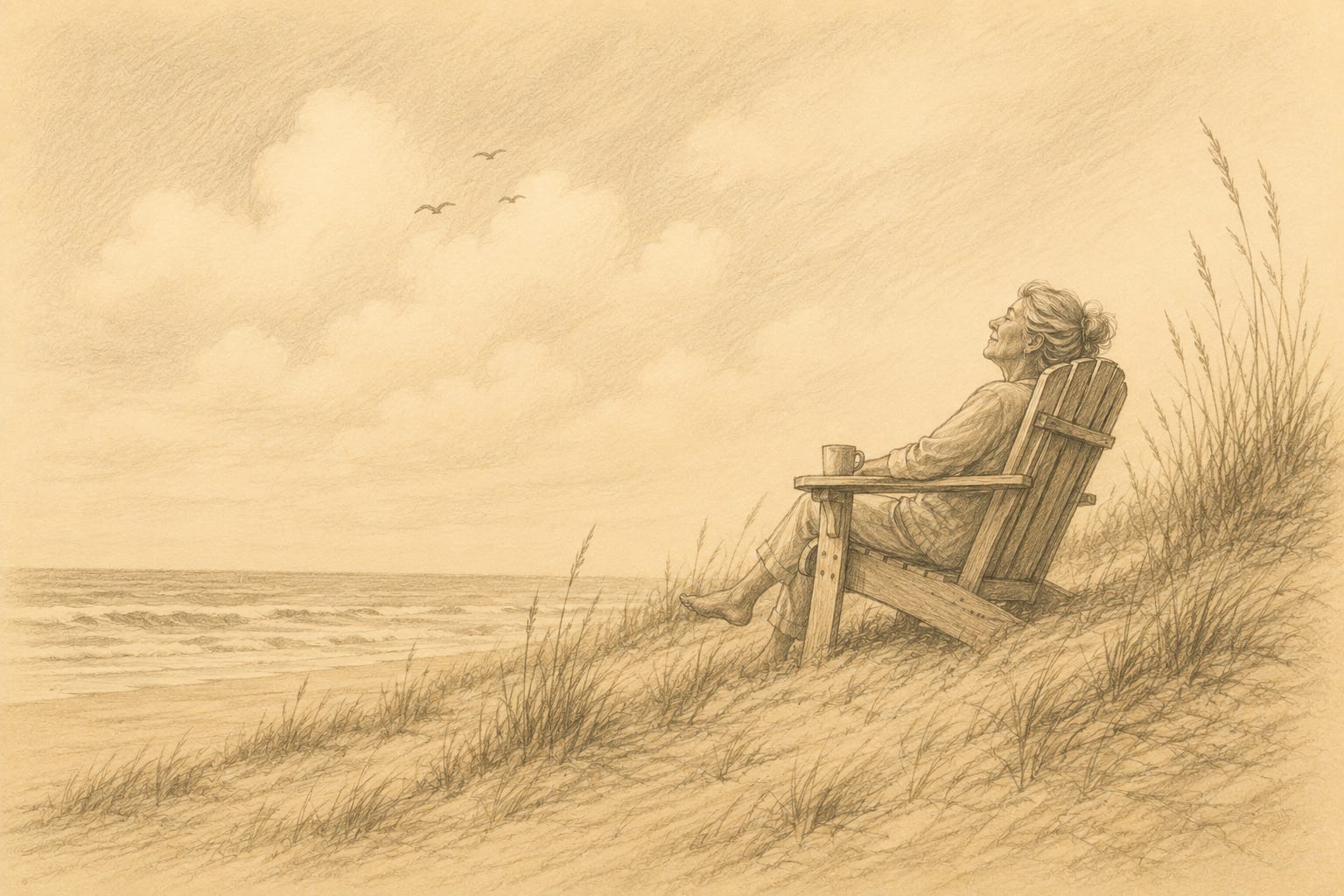
I first learned to work with dreams clinically at Pacifica Graduate Institute. In Pacifica founder Stephen Aizenstat’s style of dream tending, we are invited to use our dreams as starting points for imaginal journeys, and to deepen into Jung’s practice of active imagination. In many of my own imaginal journeys, my maternal grandmother shows up, usually lounging in a beach chair. I remember her for her warm chuckle and the endless activity of her hands -- always crocheting, cooking, gardening, canning. Lounging was not something I ever saw her do in waking life.
In the dreamscape, I am itching to get going. I want to set off on an adventure, but she tells me to stop, to sit beside her, that there is no hurry. Life is not a race to the finish line. She is tending a garden (while lounging in the beach chair) and showing me the value of patience. First we prepare the soil and plant the seeds. Then we wait. When the plants sprout, we weed and water as needed, but mostly we wait. There are bouts of activity, yet the larger gesture is patience. This is not my strong suit. I sit next to her on the Adirondack chairs and look across the dream dunes to the ocean. Gradually I begin to feel lulled by its relentless, timeless rhythm. It is wonderful to simply slow down.
Speed is the enemy of depth
The unhealthy co-opting of our attention takes away the time we might spend in reverie, or in companionably starting at the ocean with a trusted someone at our side. We are drifting. Not downloading our week while snatching glances at our phones, but just hanging out together.
I’m reminded of Stolen Focus, Johann Hari’s book that traces the many causes of our diminishing attention spans. He concludes that the shrinkage is not our fault. To my surprise, the internet doesn’t carry all the blame, though it has done plenty. Our collective attention has been narrowing for more than a hundred years, in his telling, because the volume of information we are asked to absorb has expanded past what any one mind can hold.
Quoting Danish mathematics professor Sune Lehmann, Hari names the cost. “What we are sacrificing is depth in all sorts of dimensions. Depth takes time. And depth takes reflection.” In other words, speed is the enemy of depth. When we are exposed to more information than we can actually process, we experience what researchers call a rapid exhaustion of attention resources, and what most of us recognize as a burnt out feeling at the end of an ordinary day.
Mind-wandering is the missing condition
One of the casualties of the information explosion is down-time for the mind. When we let our minds wander, we make creative new connections. Meandering mental states like mind-wandering, daydreaming, and night dreaming sit on the opposite end of the continuum from focused, goal-oriented attention. When we engage in this kind of diffuse awareness, our ability to think and focus actually deepens.
Hari interviewed McGill neuroscientist Nathan Spreng to understand this better. According to Spreng, “the more you let your mind wander, the better you are at having organized personal goals, being creative, and making patient, long-term decisions.” Freeing the mind does three things: it allows us to make better sense of our lives, to make creative new connections, and to engage in a kind of mental time-travel that better prepares us for the future.
This kind of imaginal travel is much of what happens in dreaming. When we dream, we are exploring a wide range of possibilities, and freeing ourselves from our habitually narrower range of thought, experience and beliefs. When I return to those imaginal lounge chairs with my grandma, I notice something else. While the plants in the garden are happily growing all on their own, I’m doing something essential as well -- giving myself a break from being busy, from phone-checking and tasking. The relaxed pace feels better in my body, and from that ground I am more able to connect from a place of presence.
This lesson from dream time (and my grandmother) enriches our connection with all aspects of waking life, deepening how we show up for ourselves and others. It all starts with slowing down, taking a pause, and settling, all the way down to our bones. Allowing all our weight to be held by the beach chairs, digging our toes in the sand, hands lying still on the generous armrests.
Reference
Hari, J. (2022). Stolen Focus: Why You Can’t Pay Attention and How to Think Deeply Again. New York: Penguin Random House. (Hari dedicates this book to his grandmothers.)
A slower home for this work
This Substack is the place I am giving that slower pace a home. I am writing pieces when I have something to say, sitting with them for awhile before I share them, not aiming for a huge volume of output. My articles are sent out freely to all subscribers. I deeply appreciate you reading and engaging with what I write.
A note on AI. I have dabbled with and rejected AI as a writing tool – it speed-generates some acceptable prose interspersed with filler that adds nothing, ideas I don’t quite agree with and occasional blatant errors. It actually takes more time for me to massage an AI draft into what I really want to say than if I started from scratch. A good example of speed as enemy of depth.
A thank-you gift for subscribers
I’m planning to continue writing 2 or 3 articles a month, and sending them freely to all subscribers. They do eventually get archived and this archive is a paid subscriber benefit.
Recordings. I am also planning to add more recordings, and will test out the response to live sessions. Both of these will be offered freely to paid subscribers, and offered at a discount for everyone else.
Going forward, the rhythm will be one live session a month (except August and December), recorded for anyone who cannot attend in real time. I will also be offering some dream meditations, pre-sleep recordings, and guided inner forays based on Focusing – soothing accompaniment to facilitate slowing down and entering more dreamy states.
Anyone who subscribes through my website (drleslieellis.com) will receive a three-month complimentary paid subscription as a welcome. If the pace of everything else feels too fast, this is the counter-rhythm I am building. There is room on the lounge chair beside us, and there is no hurry.
Slowing down, going deeper - yes to your wise words. And so very hard to do, especially the slowing down , for me. Not because of work pressures, I am retired. but life pressures never stop, they just change:). In dream work, and Focusing, and all sorts of contemplation, bringing patient presence to what is wanting attention, is sooo important. How to slow down, especially when paying attention , in inner work, often, to me, seems driven by the same solution focussed, efficiency focussed values that drive most of modern life. In Focusing, I have found Describing - my body sensations, images that emerge, a really helpful way to deepen my process. I like to take a lot of time with this, to get to know more, to show my interest and kind curiosity, in this way. So, as well as describing the physical sensations I am noticing, I sometimes ask 'if this sensation had a colour/temperature/texture/scent/taste, what would that be?' The response has to come from the right brain/imaginal space , already a win :), and these responses are often helpful, and doorways into deeper understanding. Re deeper process, I really like a little book by Dr Yoram Kaufmann, 'The Way of the Image'. Kaufmann is a Jungian analyst. He describes in the book spending 3 hours (!) discussing with a patient an image in the patient's dream. seems a bit over the top, but at the end of the session, the patient was free of a very long term phobia. My theory is that Kaufmann's patience, listening and guiding the patient in this slow exploration of an image, facilitated a profound 'conversation' the client had with their inner experiencing - thoughts, memories, beliefs, sensations etc.
This resonates with me. The older I get, the more I sympathize with the old witch of the woods trope: a cabin deep in the woods, all alone, save a few cats and chickens? Sign me up! Substack is my place for slowness, too. I'm done bending over backwards for algorithms.
Enjoy your peaceful new home.