

Why Do Nightmares Repeat?
And how they can suddenly change

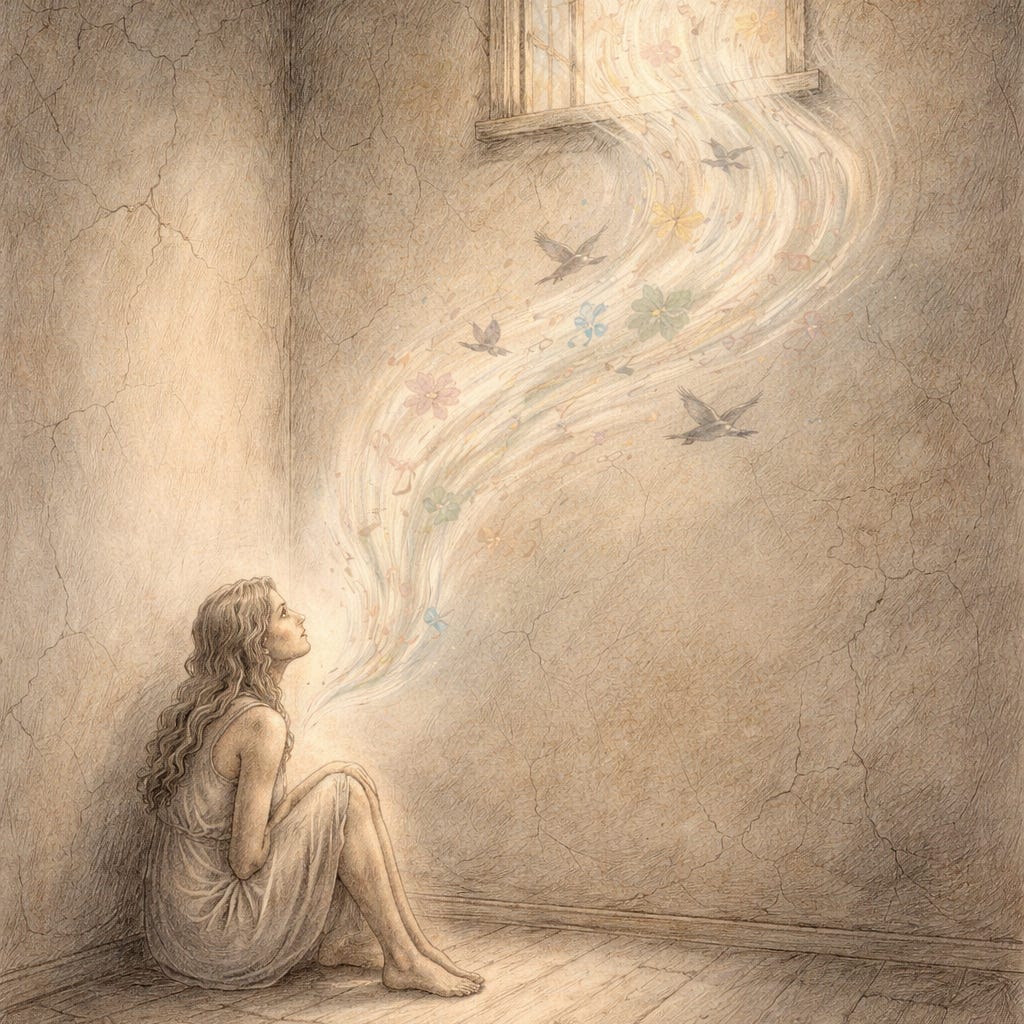
In her recurring nightmare, Anya is always trapped in her former house deep in a war-torn city filled with random explosions and widespread suffering. The dream version of the house echoes the horrors of the war: she is trapped inside and the walls are closing in on her, collapsing inward. There are no doors, no windows, no means of escape. So many nights, she would wake in terror, with the impending sensation of being crushed. The dream followed her across continents, through a new marriage, into a new life. It did not care that she was safe now. Randomly, or during times of stress, it kept returning.
When Anya (not her real name) came to therapy, she had nearly given up hope that anything could change. She had tried not thinking about the dream, tried sleeping pills, tried telling herself she was now safe and doing well. But nothing offered more than temporary relief. The nightmare seemed to have taken on a life of its own, and would reappear far too frequently, wreaking havoc on her mood and sleep.
Her dream sessions were remarkably helpful. We worked together to step back a bit from the dream and try to cultivate a sense of calm and curiosity. Armed with support, and a sense of safety in present, I invited her to revisit the frightening scenario afresh and notice anything new or helpful in the scene.
New Elements of the Dream Came to Light
The first thing Anya became aware of was that members of her family were present. I invited her to dwell on her sister, the sibling she found most supportive, and embody the felt sense of her sister’s love and protection. Then I invited her to approach the dream afresh, to place herself in the dream house and look around again. There seemed to be a lot more light, and when she looked up, she saw something new: a window, high up on the wall. It was letting in fresh air, light, and birdsong. A wave of relief washed through her body. She felt a profound shift from the dream process, one she said she needed time to sit with. As far as I know, the nightmare never returned.
I have witnessed this kind of dream transformation many times. I have seen that when the dreamer is able to revisit the dream with a calmer state of mind and body, and bring whatever resources they find helpful in the room, and in the dream, the dream itself looks different, and carries forward in surprising ways: A beast in hot pursuit sinks to its knees. There is light where it was dark. The fire-breathing dragon becomes an ally. What appeared dead comes back to life. The dreamer experiences these shifts as coming directly from the dream itself -- not as something they invented, but a new unfolding of the dream, a fluid responsiveness And once a nightmare changes like this, these shifts are reflected in dreaming life as well.
Why do some nightmares repeat for years, even decades? And why can they suddenly transform when we learn to meet them differently?
The dreams that won’t let go
We all have nightmares from time to time, particularly during periods of stress or heightened emotion. But roughly four percent of the population suffers from something more persistent: nightmare disorder, in which frequent, intensely distressing dreams disrupt sleep, impair daytime functioning, and create a dread of going to bed at all. For those with post-traumatic stress, the numbers are far higher. Up to eighty percent report nightmares, and these dreams often replay the traumatic event with terrible, precise fidelity.
Ernest Hartmann, one of the great dream researchers, described nightmare sufferers as having thin boundaries, a quality of permeability between states, between self and other, between waking and dreaming. These are often deeply feeling people whose nervous systems carry the imprint of past experiences more visibly than most. Research points to a constellation of factors: heightened emotional sensitivity, difficulty regulating intense feelings, childhood adversity, and a nervous system that remains on alert even during sleep.
But the question of why a particular nightmare keeps returning is more complex. One theory holds that nightmares are failed dreams—the normal process of emotional integration has been interrupted by overwhelming fear, and so the dream keeps returning, trying again to complete what it could not finish. The dreaming mind, rather than freely weaving past and present into something new, gets stuck in a loop. Trauma nightmares may be attempting to serve a purpose: they activate memories and emotions that are being actively avoided, invitations to metabolize our most challenging experiences. But when we wake in terror night after night, we feel anything but invited. We feel trapped.
A dangerous man at the door
A woman I’ll call Sarah came to me with a nightmare that had two parts. In the first, she was at work when a man from her past—someone she had fled years earlier after a volatile relationship—walked in with a gun. She watched in slow motion as he pulled the weapon from a brown leather holster and began firing. Somehow she dodged all sixteen bullets. In the second part of the dream, she was on a tour bus going up a mountain when she saw him waiting at the next stop. She told the driver not to open the door. The other passengers urged the driver to keep going. He did, and she was safe.
The dream made immediate sense: this man had recently moved back to her town. He knew where she worked. The terror was not irrational. But something in the dream had already begun to shift. Unlike the paralyzed victims in so many nightmares, Sarah was dodging bullets. She was speaking up. She had allies who supported her. When I pointed this out, she paused. She hadn’t noticed how much agency she already had in the dream, and just how far she had come from the helplessness of the original trauma.
This is something I see again and again: the dream is already moving toward resolution, but the dreamer is so gripped by fear that they cannot perceive it. When we slow down and look with curiosity rather than terror, we often find that the nightmare often contains its own medicine.
Dreams that change themselves
“Rescripting” is now standard practice in nightmare treatment—dreamers are asked to imagine a new ending to their dream. But in my own practice, I rarely need to ask. As I guide dreamers through a supported, embodied re-experience of their nightmares, very often the dreams change of their own accord. We are not so much rescripting the dream as re-experiencing it under different conditions: with more support, conscious emotion processing, a sense of safety. And the dream responds in real time.
How we meet our dreams colors our experience of them. They are state-dependent. When the body is terrified, dreams reflect terror. When we cultivate safety and approach with curiosity, the dream environment shifts in response. Sudden light where it was dark is a common shift. The environment becomes friendlier, and the dreamer discovers capacities they did not know they had.
Why this matters more than we realize
Nightmares are vastly undertreated. Research shows that only about eleven percent of people with frequent nightmares ever mention them to a healthcare provider. Many assume nothing can be done. Many clinicians do not ask about dreams, and when nightmares are reported, they are often viewed as a secondary symptom that will resolve when other issues are addressed. Likely these same clinicians would treat nightmares directly if they knew how.
The evidence suggests treatment of nightmares, in the more extreme cases, is imperative. These intrusive dreams disrupt the restorative sleep that healing requires. They can persist even after other symptoms of trauma have improved. And there is now substantial research linking frequent nightmares with increased risk of suicide, even after accounting for depression, anxiety, and other known risk factors. One study found that frequent nightmares resulted in a fourfold increase in the likelihood of future suicide attempts among those who had previously attempted.
The good news is that nightmares respond to treatment. The evidence is now quite robust: various approaches, including imagery rehearsal, rescripting, and lucid dreaming, can significantly reduce both the frequency and distress of nightmares. What all these approaches share is that they invite the dreamer to engage with the nightmare rather than avoid it. In my experience when we do so in a context of safety and support, the nightmares shift, change, soften and even cease to repeat.
An invitation
If you wake from a nightmare tonight, try this: instead of pushing the dream away, take a few slow breaths and let your body settle. Then, when you feel ready, turn toward the dream and look around. Was there anything in that dreamscape, however small, that carried a quality of help or strength? A voice in the distance, a patch of light, an object that felt solid? If the dream were to continue forward to a new place that feels more resolved, imagine how it might carry forward. This simple rescripting has the power to shift the trajectory of the dream.
The nightmare may have more to offer than terror. Like Anya’s window letting in birdsong, like Sarah’s allies on the bus, there may be something in your dream that has been waiting for you to notice it. Finally, the dream that has haunted you may be ready to transform.
If you’re new here, you may want to start with my essay on The Radical Intelligence of Dreaming, where I describe how I came to see dreams as an active process of emotional integration.
For those who want to go deeper:
I have developed two online nightmare courses, Working with Nightmares, a comprehensive nightmare course for clinicians and Nightmare Relief for Everyone, a short course for all. For those who want an even deeper dive into dreams, consider my year-long hybrid Embodied Experiential Dreamwork certification program.
I would love to hear from you. Have you experienced recurring nightmares? Have they ever changed on their own, or with help? What has your relationship with these dreams been like?
This was very informative and eye opening. I’ve been collecting stories from people who have had different recurring dreams and I find recurring nightmares especially interesting. Now I know the importance of resolving these dreams for the health of the individual. Thank you 🙏
Thank you for a lovely article with your two vivid examples of re-experiencing a dream "under different conditions: with more support, conscious emotion processing, a sense of safety. And the dream responds in real time."
Upon waking up from a scary dream fragment, I shift over from facing one side of the room to facing the other side while letting the 'little bit of help' in the dream appear and guide me.