

Why Do We Dream?
Lots of theories, no definitive answer - but we can embrace the mystery.

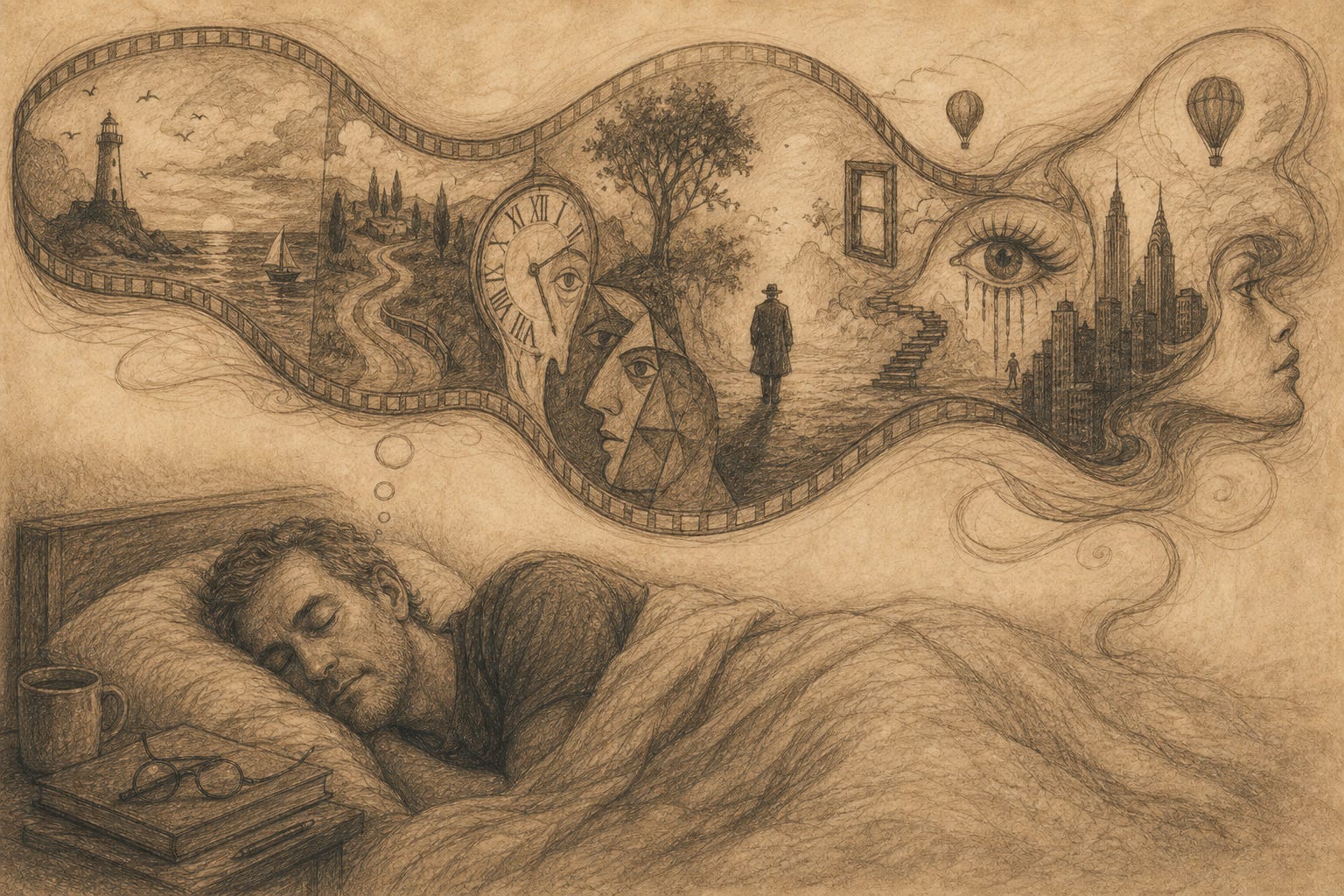
After more than a century of formal research, science still cannot tell us definitively why we have dreams. Philosophers, researchers and clinicians have many useful theories about dreaming, but there is no consensus. We dream for roughly two hours every night, often in spectacularly imaginative fashion. While we sleep, we conjure up detailed worlds populated by an odd mix of strangers, celebrities, people we’ve forgotten and people we love most. Our dreams can be set in impossible landscapes or achingly familiar ones, or a combination of both. Dreams engender feelings deep enough to linger for hours, sometimes years, after waking. The question, why do we dream is one of the oldest we humans ask ourselves.
First, a practical and obvious answer. For roughly 16 hours a day, we are bombarded with sensory input, and the pace of this barrage in modern life can be overwhelming. When we settle in to sleep, we close the gates to all of this sensory input, and for roughly eight hours, we can process and make sense of all the input in relative peace. But our brain doesn’t just shut off, it goes through a kind of wash cycle, first with deep rest and then cycles of dreaming where, among other things, we begin to integrate what’s important to us and weave it into the narrative of our lives.
In my clinical work with dreams, I have had the privilege to explore the nature of dreams in a meandering, experiential way with many clients and students. In the lab, the inquiry is more precise and systematic, and the two approaches are often worlds apart. Researchers apply exacting standards of proof and concern themselves with foundational questions about the nature of dreaming, including the tricky problem of how to glean empirical data from such a private, subjective experience. Clinicians are more concerned with personal and direct understandings: how can the dream serve the client in front of them? How do their dreams unfold over time? What are the enduring themes? So the answer to why we dream is different depending on how you approach the question.
After thirty years of working with dreams, I have come to believe that the question of why we dream may not even be the right one. Dreams seem to do so much at once that asking why we dream is like asking why we think. The answer, as the dream researcher Deirdre Barrett puts it, is “for everything.”
Many stories, all true yet incomplete
The modern science of dreaming began in 1953, when Eugene Aserinsky and Nathaniel Kleitman discovered rapid eye movement (REM) sleep, the stage most closely associated with vivid dreaming. Researchers thought they had finally found a window into the sleeping mind. Decades of work since has shown the picture is messier than that: we dream throughout the sleep cycle, not only in REM, and we sometimes don’t dream during REM at all. All mammals appear to dream, since they all experience REM, and humans get about ninety minutes of it each night. What remains an open question, despite all the inquiry, is the function of dreaming.
Four major theories have substantial research support, and rather than pitting one against the other, I tend to think they are all partly true. The first proposes dreams as a kind of simulation, a place where the mind rehearses scenarios it might face in waking life. Threatening scenarios are overrepresented in dreams, which makes evolutionary sense; our ancestors who practiced evading predators while asleep may have been better prepared to do so by day. More recent extensions of the theory broaden simulation to include social rehearsal, the working out of relationships and the small calibrations of belonging.
A second theory holds that dreams regulate emotion, metabolizing feelings we could not fully process during the day. Rosalind Cartwright’s research on people moving through the aftermath of divorce showed that those who dreamt directly about the marriage and its end recovered more quickly from situational depression than those whose dreams remained stuck in happier memories or who couldn’t recall dreaming at all. Cartwright described this as a “wake-sleep collaboration” — dreaming as a way to keep our behaviour flexible and metabolize unanticipated misfortunes. “Without enough dreaming,” she wrote, “we are stuck with our unregulated emotional memories.” In this widely-held view, the dreaming mind is doing real psychological work on our behalf.
A third theory positions dreams as central to memory consolidation. In a landmark experiment Harvard researchers Robert Stickgold and Erin Wamsley showed that subjects who learned a virtual maze and then napped and dreamt of maze-like material showed improvement in performance. Those who didn’t sleep at all, or those who slept but had no relevant dreams, did not improve their performance at all. The dreams themselves were strange and tangential, meeting a friend in a maze, travelling through bat caves, hearing the test’s background music. Stickgold quipped, “Profoundly useless, can we all agree on that?” Yet these were the people who improved. While there are some valid critiques of this research, there is also growing body of research linking dreaming and memory.
A fourth view is that dreams are vehicles for creativity and problem-solving. Dreams make associations far beyond what the linear waking mind can reach. Respected and prolific dream researcher Michael Schredl, after analyzing more than twelve thousand of his own dreams, concluded that creative problem solving is dreaming’s primary function. Newer theories continue to arrive. Erik Hoel proposes that dreams introduce noise and bizarreness to keep our brains from “overfitting” to recent experience, the way a machine learning model trained too tightly on old data fails when analyzing new situations. Stickgold and Antonio Zadra’s NEXTUP framework proposes that dreaming is the predictive brain exploring weak associations and possibilities that more focused waking thought never reaches. Other proposed purposes include dreams as imaginative play (Bulkeley), as increasing empathy (Blagrove and Lockheart), as protectors of sleep (Freud), and as compensation and information from the collective unconscious (Jung). The above list is long (and not nearly complete) because dreaming is doing so much at once, we need many theories to account for it.
Dreams are ‘not an alien intrusion’
Among the most respected dream researchers of the last century, Ernest Hartmann spent his career trying to make sense of this multiplicity. He came to see dreaming at one end of a continuum of mental activity, with focused waking thought at the other, and mind wandering and reverie somewhere between. Dreams, he argued, are “simply one form of mental functioning, not an alien intrusion.” What distinguishes dreaming from other forms of thought is not its occasionally bizarre content but what he called hyper-associativity. This is the dreaming mind’s capacity to weave together disparate elements (such as recent experience, emotional concerns, bodily signals, the vast archive of memory) into something original, surprising and reflective of the emotions most alive in us.
A dream, in Hartmann’s view, always brings something new; it is never simply a replay of the past. When the mind is in dreaming mode, it is more apt to make distant and unusual connections. Stickgold made the same point from a neurobiological lens: “The average person thinks the brain shuts off when you sleep, but the brain is working all night long.” It is the same brain “running a different program.”
Where the science fails us
For all that research has illuminated, there is a deep end of dreaming that current scientific methods cannot reach. People report dreams that seem to arrive from beyond their personal history: visitations from the dead that feel qualitatively different from ordinary dreams, encounters with autonomous and apparently wise presences, dreams that turn out to be prescient. Jung spoke of the collective unconscious, a vast reservoir of human experience the dreaming mind can tap into. Others have gone further, suggesting we dream not only as individuals but as part of a larger dreaming that moves through all of us.
I hold these possibilities with an open mind. What I know from decades of dream exploration is that dreams possess a remarkable emotional intelligence, an integrative capacity to reorganize experience in ways that have the power to move us deeply, both individually and collectively. The majority of our dreams are forgotten, which suggests they do their work whether we remember them or not. But when we engage with the dreams we do recall, we glimpse this intelligence at work.
Watching a dream change in the room
In thirty years of clinical practice, I have witnessed hundreds of people re-enter their dreams and experience them transforming in real time. I have seen nightmares that have repeated for years start to morph when the dreamer enters the dreamscape with more open curiosity. This shift away from fear and suspicion happens when I guide dreamers to first locate and embody the supportive elements already present in the dream. When they are able to do so, the dream changes too. For example, terrifying figures soften, dangerous falls land softly, or the whole constellation of the dream simply shifts to a new scene. These changes point toward something I have come to believe about dreaming itself: dreams are not static narratives but living processes that respond to our attention and the feelings we bring to them.
During the hours that we dream, we are not passive watchers — our brain and body are more active in some ways than when fully awake. In dreaming we are engaged in a process of emotional integration that continues all night. When we approach dreams with openness and respect, rather than trying to decipher them like puzzles or dismiss them as noise, they reveal themselves as collaborators in our own becoming.
A better question
So why do we dream? My truest answer is that dreaming is one of the mind’s most sophisticated ways of helping us become more fully ourselves. Dreams weave our scattered experiences into something uniquely meaningful, they help us process emotions we could not face by day, prepare us for challenges we haven’t yet encountered, and occasionally offer glimpses of the transcendent. They do all this while we sleep, whether we remember them or not.
The next time you wake from a vivid dream with the lingering sense that something important just happened, trust this feeling. The dreaming mind has been working through the night making connections, processing emotions, and integrating experiences that are important to you.
Why we dream may be the wrong question.
A better one is: how do we listen to our dreams in a way that allows us to collaborate with the depth of intelligence and integration they offer?
— — —
I’d love to hear your thoughts in the comments. What has dreaming revealed to you? Have you had dreams that seemed to serve a clear purpose, or ones that defied any explanation? Why do you think we have dreams?
If you’re new here, you might want to start with my foundational essay, The Radical Intelligence of Dreaming, where I describe how I came to see dreams as an active process of emotional integration. For a fuller treatment of the science discussed in this piece, including the theories of Hartmann, Stickgold, Cartwright, Schredl and others, see Chapter 4 of my book, A Clinician’s Guide to Dream Therapy: Demystifying Dreamwork (Routledge, 2025).
Acknowledging the value of my dreams came to me later in life--previously, I had ignored them. Now, I call them my nighttime life — filled with a wide diversity of experiences and insights. My dream journal sits by my bedside and is full of late-night scribbles, capturing the fleeting nature of dreams so I can process them further in the light of day. What a joy to have discovered part of my existence.
I think dreams are rooted in all of the above, and so much more. You asked about a dream that defies explanation. Here's mine:
I was floating above an interstate off-ramp near my home. It was dark and the only light was from interstate streetlights and sporadic vehicle headlights. I knew it must be the wee hours of the morning. Suddenly, a car flew down the off-ramp and a terrible wreck ensued at the T-intersection at the foot of the off-ramp. Here the dream ends.
I woke up early for work, got a cup of coffee, and turned on the morning news just as the anchor began a report on an overnight accident. Suddenly there was a news helicopter view of the off-ramp in my dream, complete with the exact same accident from my dream. "Wait wait wait, is that the same one?" I thought, and without warning the TV picture froze on the scene of the crash. I took a quick photo. The picture remained frozen until I turned the TV off then back on.
That TV never froze. The news anchor hadn't commented on the frozen scene so I knew it was my TV, not the helicopter feed. I was and am still astonished by this, and I'm no stranger to the other realms thanks to experience with evidential and physical mediumship, energy work, animal communication, etc.
At that time I had been dabbling in daily dreamwork and felt a pull to delve deeper into it, but had been resisting it for years. I began having dreams of overnight events local to me, as they were occurring, or of seemingly random things that occurred the following day in powerful synchrony. Yet I was firmly in the corporate world and resisted the pull. My guess is, something was telling me to pay closer attention.